Development of CBCT software for TMJ assessment
Software-supported analysis of selected anatomical and geometric TMJ parameters based on CBCT imaging.
Client
MIV PSA
Country
Poland
Industry
Dentistry, Dental Prosthetics, Medical Imaging
Collaboration
Since December 2025
Device Classification
Prepared for MDR Class IIa, IEC 62304 Class B
Scope
Web App, Desktop App, Backend, Frontend, Regulatory Consultations, Project Management, QA, Documentation and Risk Analysis
Technologies
Python, React, AWS Cloud Infrastructure, PostgreSQL, VTK, PySide 6, Stripe, DICOM
Executive summary
This medical imaging software development project translated a proprietary TMJ assessment methodology into medical software under development, with documentation supporting future MDR conformity assessment.
Client: MIV PSA (Medical Devices, Poland)
Challenge: Transforming a proprietary TMJ diagnostic support methodology into an MDR-ready medical device while protecting intellectual property and supporting precise CBCT-based treatment planning.
Our role: End-to-end technology partner, from software architecture and regulatory documentation to desktop and web applications delivery.
Outcome: Delivered an integrated medical software platform combining advanced CBCT analysis, secure licence management and IEC 62304-compliant software documentation, creating a scalable foundation for commercialisation and certification.
Business Context
In selected dental treatment-planning scenarios, assessment of TMJ and related craniofacial structures may provide relevant supplementary information.
MIV PSA developed a proprietary CBCT-based methodology intended to provide selected quantitative anatomical information to support professional TMJ assessment.
The software needed to:
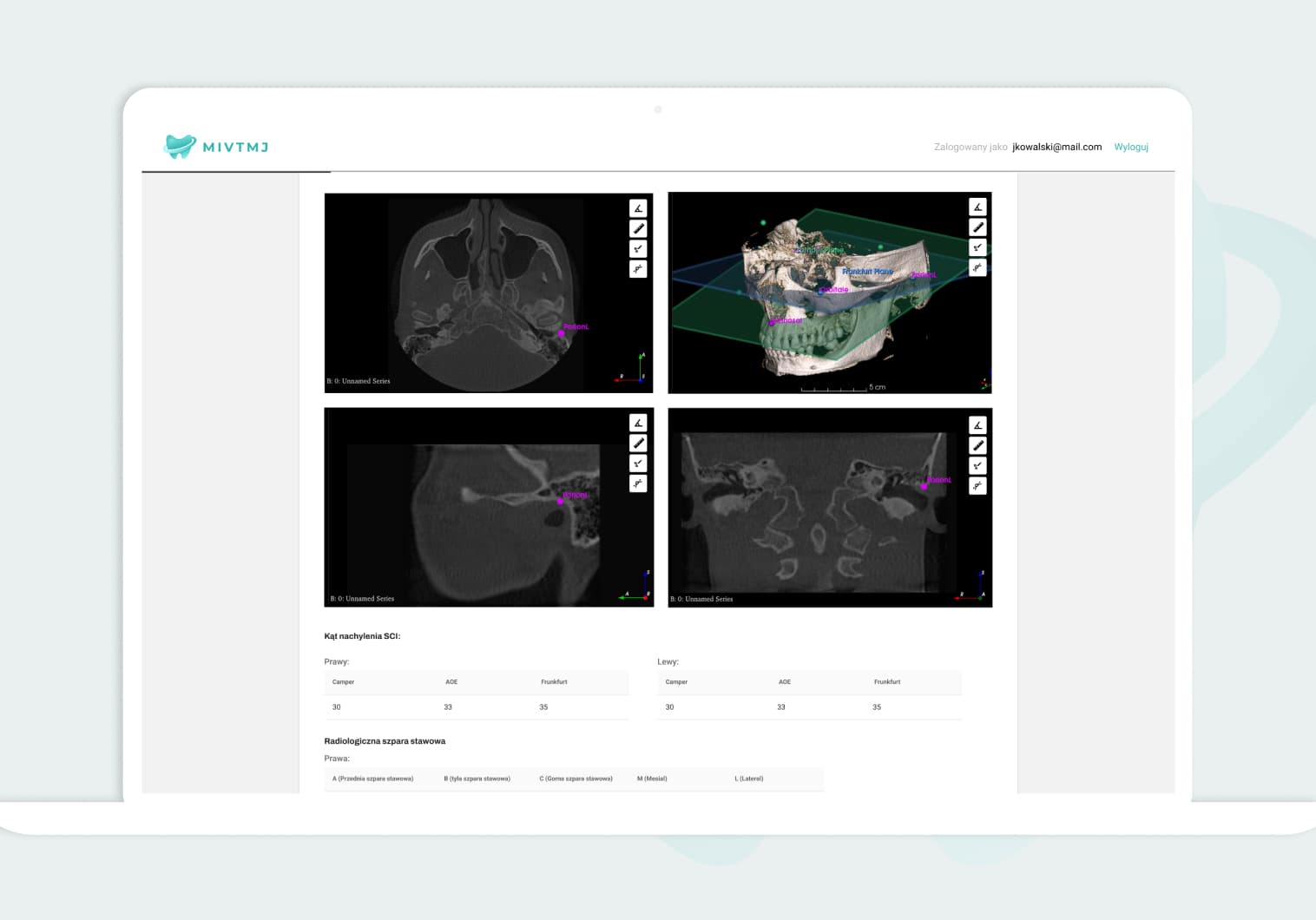
visualise CBCT scans in an intuitive clinical environment,
perform advanced TMJ measurements based on proprietary algorithms,
generate analytical reports supporting clinical decision making,
develop software lifecycle documentation with reference to IEC 62304 processes to support future MDR conformity assessment
Bringing these requirements together meant combining medical imaging software development, advanced CBCT software capabilities, cybersecurity and regulatory compliance within a software solution and supporting commercial infrastructure
The challenge
The client came to us with years of proprietary in-house clinical experience and a clear product vision. Our challenge was not inventing the assessment process, but translating years of clinical experience into medical device software development that supports reliable CBCT assessment .
In practice, the real complexity extended far beyond displaying DICOM images.
Key challenges:
implementing CBCT visualization and predefined measurement functions subject to technical and clinical validation,
protecting proprietary analytical algorithms against reverse engineering,
combining desktop analysis tool with web-based licensing and administration,
preparing software lifecycle documentation with reference to IEC 62304,
delivering a cross-platform application for Windows and macOS.
This work brought together clinical-domain expertise, cybersecurity considerations and regulatory documentation activities.
Our role: strategic technology partner
We worked alongside the client as both an engineering and regulatory partner, helping transform an in-house assessment approach into a scalable software product.
Our contribution included:
designing the overall software architecture,
defining a maintainable technology stack,
developing both desktop and web applications,
creating documentation aligned with IEC 62304,
supporting AI integration and regulatory readiness.
Rather than treating compliance as a separate activity, software engineering and regulatory documentation progressed simultaneously throughout the project.
The solution
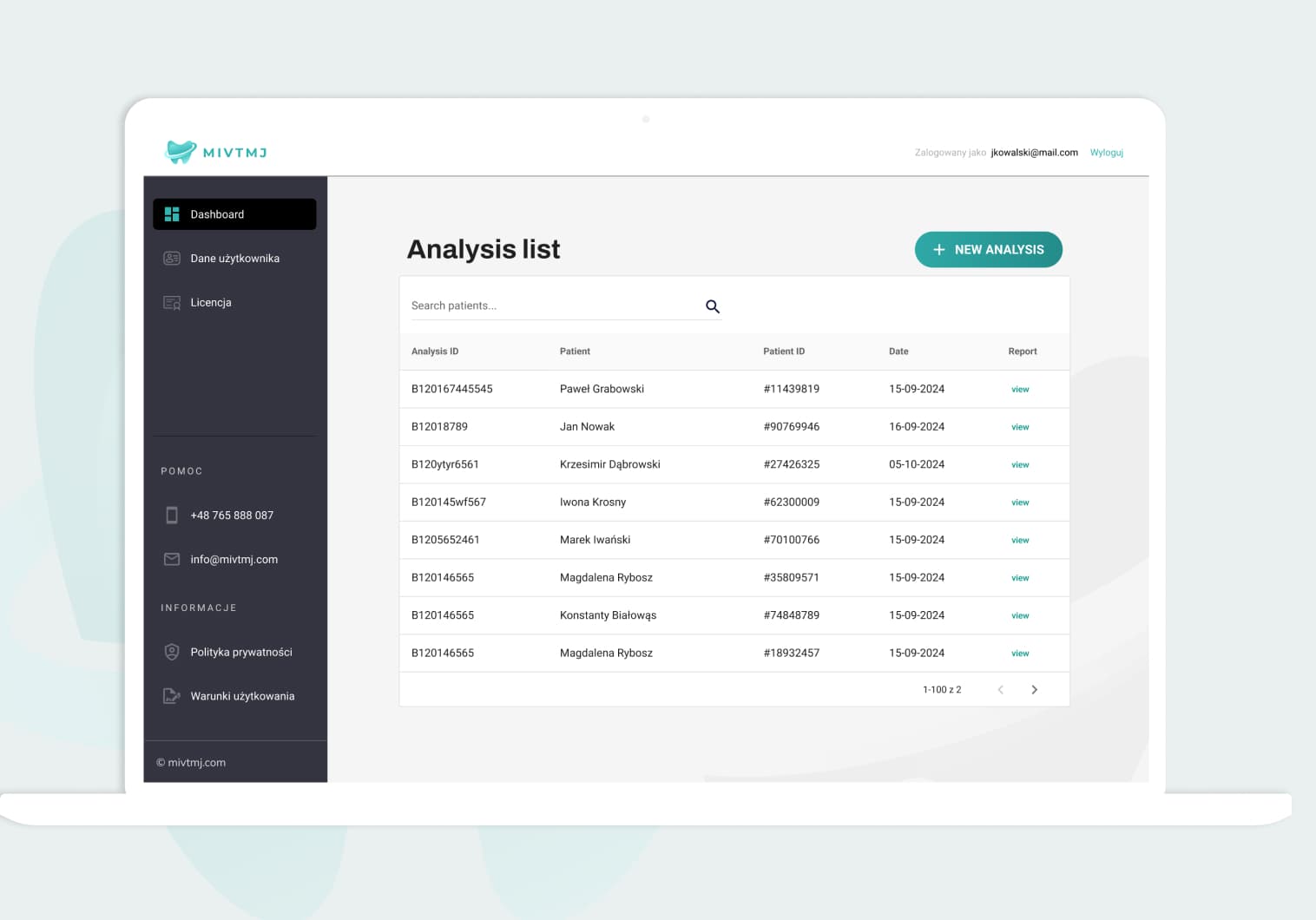
The project developed a desktop CBCT analysis application and a supporting web platform for licensing and user management.
Key capabilities
Advanced CBCT analysis
Clinicians can import DICOM studies into dedicated CBCT software that enables 3D visualisation, anatomical analysis, manual measurements, and proprietary automated TMJ parameter calculations, with the option for clinicians or experienced operators to review and manually adjust the automatically calculated parameters.
Integrated commercial platform
A dedicated web application manages organisations, users, licences, and secure authentication, providing the commercial layer of the platform. Licensing and discount management were designed independently, allowing future pricing changes without any interference with the core software.
Cross-platform deployment
Desktop software was delivered for both Windows and macOS while optimising technology choices to reduce licensing costs for the client.
Security
Protecting patient data and proprietary diagnostic algorithms required cybersecurity to become a core architectural principle from the outset.
Security was addressed on three levels:
Integrity and authenticity of the software including digital signatures, verification of every release, and protection against unauthorised modification to ensure that the application cannot be silently altered or replaced.
Continuous oversight of the runtime environment by monitoring critical files and verifying trusted components to detect and block interference while the application is running.
Proactive validation of security measures through regular testing of the live system against real-world attack scenarios, ensuring that defenses remain effective over time.
These measures help protect both patient data and the client's intellectual property while reducing the risk of software tampering and unauthorised modification.
Software and MDR Compliance
Regulatory compliance was integrated into the development process rather than addressed as a final project phase.
Software life cycle documentation was prepared in line with IEC 62304, and software-specific MDR requirements , including:
software architecture documentation,
software lifecycle documentation,
software risk management,
requirements traceability,
SOUP management,
software change management.
Project in numbers
0
2
applications
0
9
specialists
0
7
months
Delivery and collaboration
Development followed an agile delivery model with continuous collaboration between engineering, regulatory and clinical experts.
Our delivery approach included:
regular workshops and planning sessions
transparent communication through Slack, GitHub, Jira and Confluence
on-site meetings at the client's clinic to understand diagnostic workflows
continuous review of technical implementations to ensure software verification readiness
This collaborative model enabled rapid delivery without compromising full requirements traceability across development activities, in line with IEC 62304 requirements.

The results
The outcome was a complete medical imaging software platform combining advanced TMJ analytical support with commercial readiness and software compliance.
An integrated technical platform comprising a desktop analysis application and a supporting web licensing portal.
Structured TMJ assessment workflow, combining CBCT visualization, predefined automated measurements and professional review. The underlying analytical algorithms in close collaboration with MIV P.S.A., combining the client's clinical expertise and domain knowledge with our software engineering and algorithm development capabilities.
Reduced technical and regulatory risk, with software documentation developed alongside implementation in accordance with IEC 62304 principles.
Protected intellectual property, through multiple layers of application hardening that safeguard proprietary analytical algorithms against tampering and reverse engineering.
A scalable product foundation, allowing future expansion with AI-assisted analytical capabilities, additional clinical features and commercial growth without redesigning the core architecture.
Cross-platform availability, enabling clinicians to use the software on both Windows and macOS while keeping licensing costs under control.
Developing software for advanced CBCT analysis requires more than technical expertise. Revolve understood the clinical purpose behind our solution and helped us turn a complex diagnostic methodology into a structured, secure software platform, while keeping future regulatory requirements in mind.

Project Manager at MIV PSA
Building medical imaging software under MDR?
We help turn complex medical imaging concepts into software with structured development and regulatory documentation processes.